Getting your Green Card is a massive milestone. It’s the ticket to building your life, career, and future in the United States. But along with that shiny new status comes a web of legal and financial responsibilities that many newcomers completely miss.
One of the most dangerous—and common—misconceptions among Lawful Permanent Residents (LPRs) is that U.S. laws only apply to what they do inside the United States.
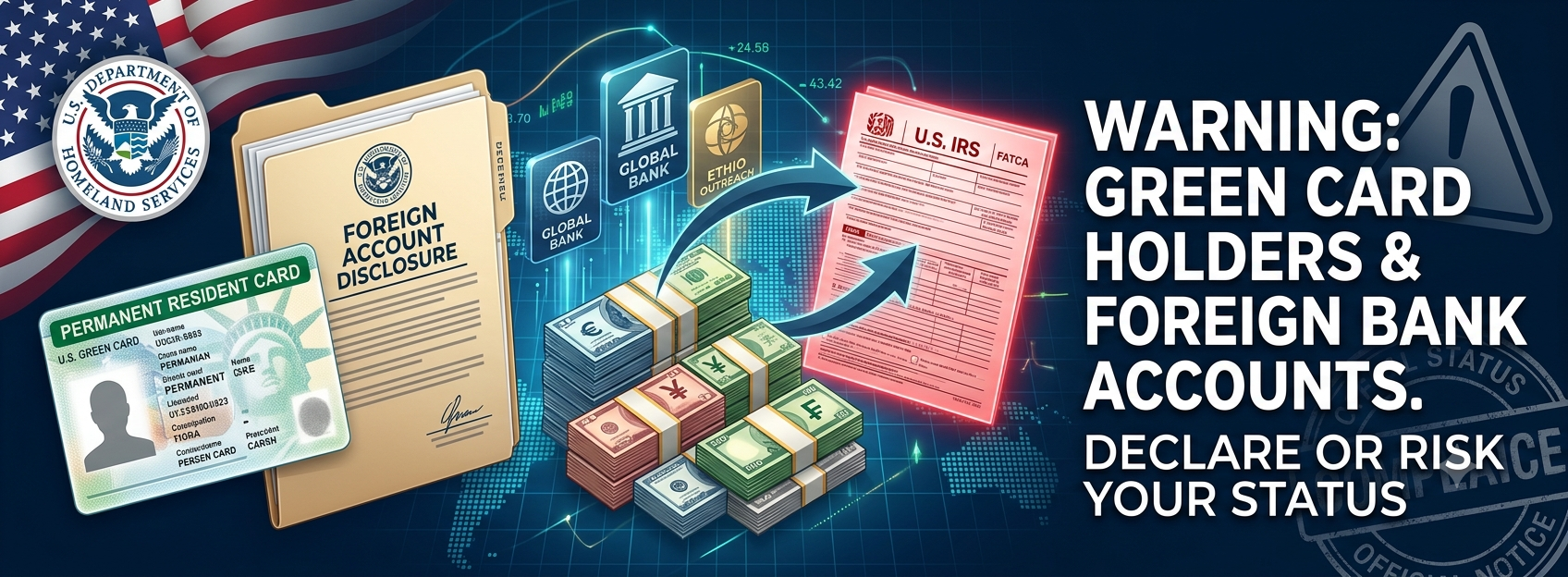
Here is the hard truth: If you hold a Green Card and keep bank accounts, property, or investments back in your home country, hiding them (even accidentally) can cost you your savings, your Green Card, and your future U.S. citizenship.
Here is what you urgently need to know about declaring your foreign bank accounts.
The Big Misconception: “I’m Not a Citizen Yet”
Many Green Card holders believe that because they cannot vote and do not hold a U.S. passport, the Internal Revenue Service (IRS) and U.S. Citizenship and Immigration Services (USCIS) have no right to look at their assets abroad.
The Reality: For tax and financial reporting purposes, the U.S. government treats Green Card holders exactly like U.S. citizens.
From the very first day your Green Card becomes valid, you are considered a “tax resident.” This means you are legally required to report your worldwide income and declare your foreign financial assets.
The Two Crucial Rules You Must Know: FBAR and FATCA
The U.S. government tracks foreign wealth through two primary mechanisms. If you cross their financial thresholds, you are legally required to file.
1. The FBAR (FinCEN Form 114)
- What it is: Foreign Bank and Financial Accounts Report.
- The Threshold: If the total value of all your foreign bank accounts combined hits or exceeds $10,000 at any single point during the calendar year.
- Important Detail: This is not just about having $10,000 in one account. If you have three accounts with $3,500 in each, your total is $10,500—meaning you must file. Even if the money just sat there and earned zero interest, it must be reported.
2. FATCA (Form 8938)
- What it is: Foreign Account Tax Compliance Act.
- The Threshold: Generally, if you live in the U.S. and your foreign financial assets are worth more than $50,000 on the last day of the year (or $75,000 at any point during the year). For married couples, these thresholds are higher.
- How it’s filed: This form is attached directly to your annual federal tax return (Form 1040).
How This Can Ruin Your Immigration Status (USCIS Impact)
You might think, “Okay, this is a tax issue. What does it have to do with my immigration status?”
Everything. USCIS and the IRS share data, and financial transparency is a core requirement for maintaining permanent residency and upgrading to citizenship.
- The Citizenship Block (Form N-400): When you apply for naturalization to become a U.S. citizen, USCIS will meticulously review your tax history. One of the primary requirements for citizenship is demonstrating Good Moral Character.
- The “Fraud” Label: If USCIS discovers you failed to report foreign income or hide bank accounts, they can view this as tax evasion or willful misrepresentation (lying to the government). This can lead to an immediate denial of your citizenship application.
- Financial Ruin: The penalties for failing to file an FBAR are terrifying. If the IRS determines your failure was non-willful (an honest mistake), the fine can still be thousands of dollars. If they prove it was willful (intentional), the penalty can be up to $100,000 or 50% of the account balance—whichever is greater.
“I Didn’t Know About This! What Do I Do?”
If you just realized you are out of compliance, do not panic, and do not try to fix it by quietly moving your money around. That will only make it look intentional.
The IRS offers a lifeline called the Streamlined Filing Compliance Procedures. This program is designed specifically for people who made an honest mistake because they didn’t know the law. It allows you to catch up on your back taxes and FBAR filings with significantly reduced or entirely waived penalties, as long as you come forward voluntarily before the IRS catches the error.
Your Next Steps:
- Gather your records: Find the peak balances for all your foreign accounts over the last few years.
- Talk to a professional: Do not use a generic tax software. Consult a Certified Public Accountant (CPA) or a Tax Attorney who specializes in U.S. expatriate or international tax law.
- Be honest on your taxes: Moving forward, always check “Yes” on Schedule B of your tax return if you have foreign accounts, and ensure your FBAR is filed by April 15th every year.
Bottom Line
Protecting your Green Card means protecting your financial transparency. The U.S. government doesn’t mind you having money abroad; they just want to know about it. Stay informed, stay compliant, and protect the future you are building in America.